
How Christian Denominations Were Created
A biblical and historical guide to why denominations exist, how they developed, and what Christians should understand about unity, doctrine, and church history.
Table of Contents
- Why Are There So Many Christian Denominations?
- The Early Church Before Denominations
- Early Doctrinal Conflicts and Church Councils
- The Great Schism of 1054
- The Protestant Reformation
- Why More Denominations Formed After the Reformation
- Major Christian Denominational Families
- Are Denominations Biblical?
- Healthy Differences vs False Teaching
- What Christians Should Do Today
- FAQ About Christian Denominations
Why Are There So Many Christian Denominations?
One of the most common questions people ask about Christianity is this: If Christians believe in one God, one gospel, and one Bible, why are there so many denominations?
The answer is historical, theological, and practical. Christian denominations did not appear all at once. They developed over centuries as churches wrestled with doctrine, church authority, worship, sacraments, leadership, reform, and cultural expansion.
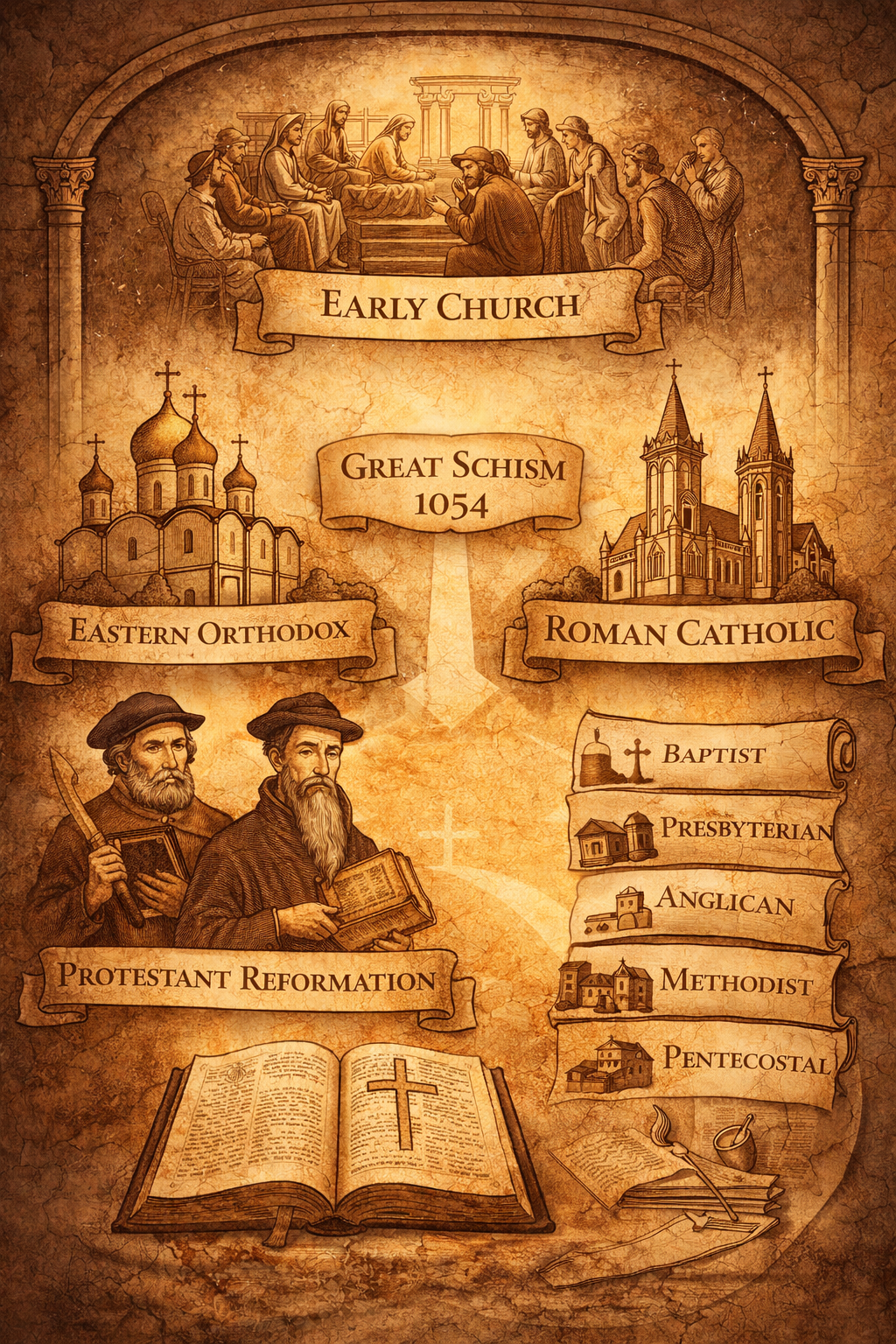
To understand how Christian denominations were created, you need to understand four major stages:
- The unity of the early church
- Doctrinal debates and institutional conflicts
- The split between East and West
- The Protestant Reformation and later denominational growth
The Early Church Before Denominations
In the first centuries of Christianity, believers did not identify as Baptist, Presbyterian, Lutheran, Methodist, or Pentecostal. The earliest Christians were united around the apostolic gospel, the teaching of Scripture, prayer, fellowship, and the lordship of Jesus Christ.
The New Testament presents the church as one body in Christ. Christians met in local congregations, but they understood themselves to belong to the one universal church.
“There is one body and one Spirit… one Lord, one faith, one baptism.” — Ephesians 4:4–5
That unity, however, did not mean there were no disagreements. Even in the New Testament, churches struggled over doctrine, false teaching, leadership, and practical issues. The difference is that these disputes had not yet developed into the later denominational structures we know today.
Early Doctrinal Conflicts and Church Councils
As Christianity spread through the Roman world, debates emerged over the Trinity, the nature of Christ, Scripture, church authority, and heresy. These conflicts forced Christian leaders to define orthodox teaching more clearly.
Important councils such as Nicaea helped clarify doctrines that remain central to historic Christianity. These councils did not create denominations in the modern sense, but they did show that visible Christian unity always required theological boundaries.
In other words, denominations eventually formed not only because people liked different styles, but because Christians often divided over what they believed to be essential truth, church order, and biblical faithfulness.
The Great Schism of 1054: East and West Divide
The first major visible break in Christianity came in 1054, when the Christian world split into what became the Roman Catholic Church in the West and the Eastern Orthodox Church in the East.
This event is commonly called the Great Schism. It was not caused by one issue alone. It involved disputes over papal authority, long-standing cultural and political tensions, language differences between Latin-speaking West and Greek-speaking East, and theological disagreements.
After this split, Christianity no longer existed as one single visible institution across East and West. That division remains one of the most important turning points in the history of Christian denominations.
The Protestant Reformation: The Biggest Engine of Denominational Growth
The largest wave of denominational development began in the 16th century with the Protestant Reformation. Reformers such as Martin Luther, John Calvin, and others challenged doctrines and practices within the Roman Catholic Church.
The Reformation did not merely create “one more denomination.” It fractured Western Christianity and gave rise to multiple Protestant traditions. Reformers agreed on some central convictions, such as the authority of Scripture and justification by faith, but they still differed from one another on church government, sacraments, and worship.
Britannica notes that the Reformation became the basis for Protestantism and contributed to the division of Western Christendom between Roman Catholicism and new Protestant traditions.
Core Reformation Themes
- Scripture as final authority
- Salvation by grace through faith
- Reform of church doctrine and practice
- Resistance to abuses and unbiblical traditions
Why More Denominations Formed After the Reformation
After the Reformation, Protestants continued to separate into distinct denominational families. Why? Because even people who agreed on the gospel often disagreed on important secondary matters.
Common Reasons Denominations Formed
Church Government
Should churches be ruled by bishops, elders, or congregational vote?
Baptism
Should only believers be baptized, or should infants be baptized too?
Communion
What happens in the Lord’s Supper, and how often should it be observed?
Worship
How formal or simple should worship be? What role should liturgy play?
Spiritual Gifts
Do miraculous gifts continue today, or were some temporary?
Church and Culture
How should the church relate to the state, society, and mission strategy?
Over time, these disagreements created recognizable denominational identities. Britannica describes Protestantism as developing into major confessional families such as Lutheran, Anglican, Reformed, and Free Church traditions.
Major Christian Denominational Families
Today, many denominations can be grouped into broader historical families. This does not eliminate their differences, but it helps explain where they came from.
Roman Catholic
Rooted in the Western church, centered historically on papal authority and sacramental theology.
Eastern Orthodox
Rooted in the Eastern church after the Great Schism, emphasizing continuity with the early church and conciliar tradition.
Lutheran
Emerging from Martin Luther’s reforms, emphasizing justification by faith and the authority of Scripture.
Reformed / Presbyterian
Shaped by Calvin and related traditions, emphasizing God’s sovereignty, covenant theology, and elder-led church government.
Anglican
Developing in England, combining reformed theology with historic liturgy and episcopal structure.
Free Church / Baptist / Evangelical
Emphasizing local church autonomy, believer’s baptism, and strong focus on conversion and biblical preaching.
Are Denominations Biblical?
The Bible does not command Christians to create denominations as modern institutional structures. At the same time, Scripture clearly shows that truth matters, doctrine matters, and visible unity can be broken when serious disagreements emerge.
The New Testament calls believers to unity, but it also warns against false teaching and commands churches to guard sound doctrine. That creates a tension Christians still live with today: unity should be pursued, but not at the expense of the gospel.
“That there be no divisions among you…” — 1 Corinthians 1:10
“Contend for the faith that was once for all delivered to the saints.” — Jude 3
A healthy Christian view recognizes that some denominational differences involve secondary issues, while some divisions have arisen because believers believed the truth of the gospel itself was at stake.
Healthy Differences vs False Teaching
Not every difference creates a false church. Some Christian denominations differ on secondary matters while still affirming the core truths of historic Christianity.
Healthy Denominational Differences
- Baptism practice
- Church polity
- Worship style
- Views on spiritual gifts
- Timing of end-times events
False Teaching That Crosses the Line
- Denying the deity of Christ
- Denying the resurrection
- Changing the gospel of grace
- Rejecting biblical authority
- Replacing Christ with another mediator or savior
This distinction matters. The existence of denominations does not mean all groups are equally biblical. Christians still need discernment.
What Christians Should Do Today
If you are trying to make sense of denominations, the goal is not to become obsessed with labels. The goal is to find a biblically faithful church that teaches Scripture clearly, preaches Christ faithfully, and lives out the gospel.
Christians should care about both truth and unity. A denomination can be useful if it helps preserve doctrine, accountability, and mission. But denominational loyalty should never become greater than loyalty to Jesus Christ and His Word.
The best question is not merely, “What denomination is this?” but, “Is this church faithful to the gospel, grounded in Scripture, and committed to Christ?”
FAQ: How Christian Denominations Were Created
Did Jesus create denominations?
No. Jesus established His church, not multiple modern denominations. Denominations developed later through church history as Christians divided over doctrine, authority, reform, and practice.
What was the first major denomination split in Christianity?
The first major institutional split was the Great Schism of 1054, which separated the Roman Catholic Church in the West from the Eastern Orthodox Church in the East.
Why did Protestant denominations form?
Protestant denominations formed because reformers broke from Rome and later disagreed among themselves on matters such as baptism, sacraments, church government, and worship.
Are all denominations wrong?
No. Many denominations share the core truths of historic Christianity while differing on secondary matters. The key issue is whether a church remains faithful to the gospel and Scripture.
1 Comment
Pingback: Why Are There So Many Bible Translations? A Clear Christian Guide – Test Every Faith